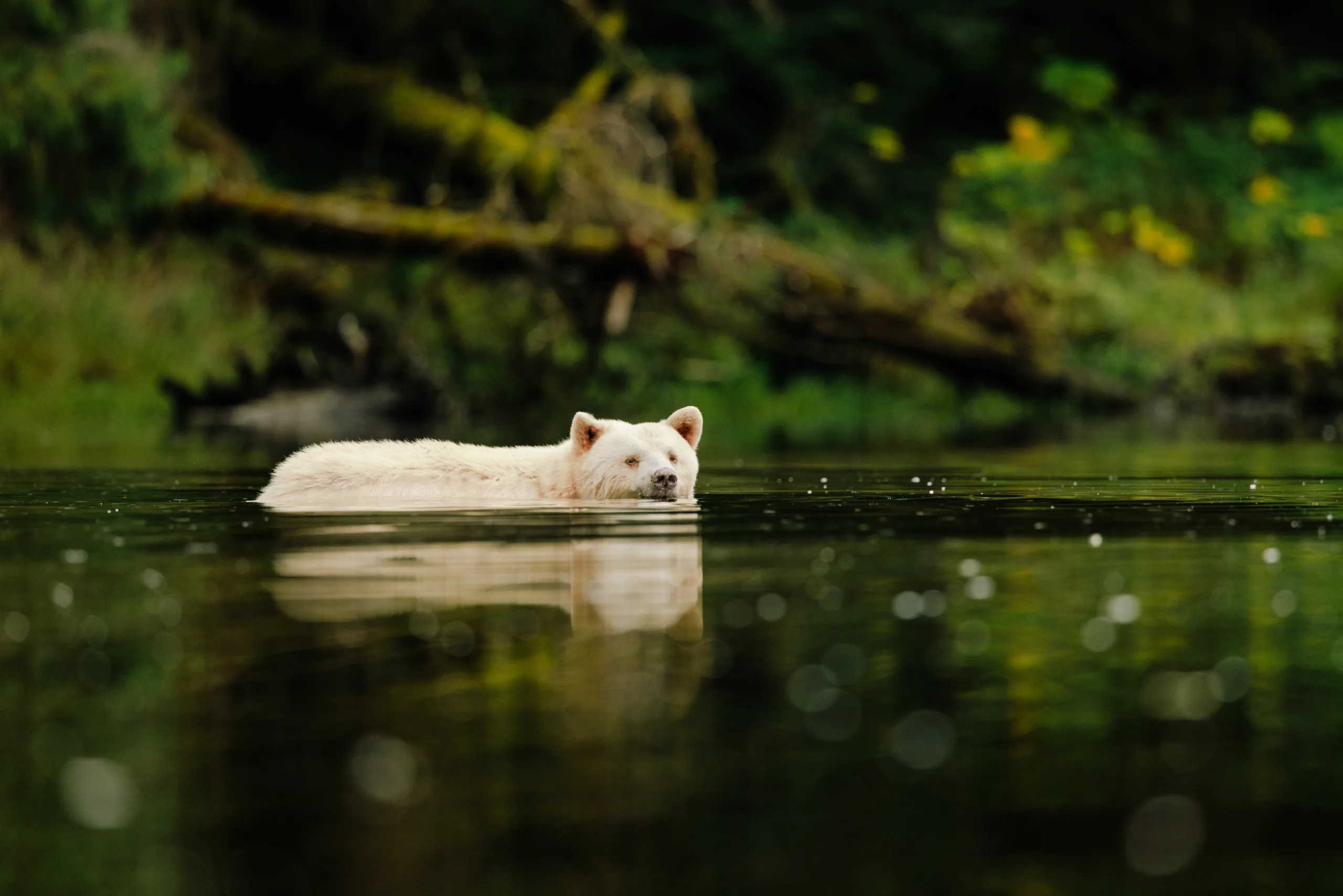
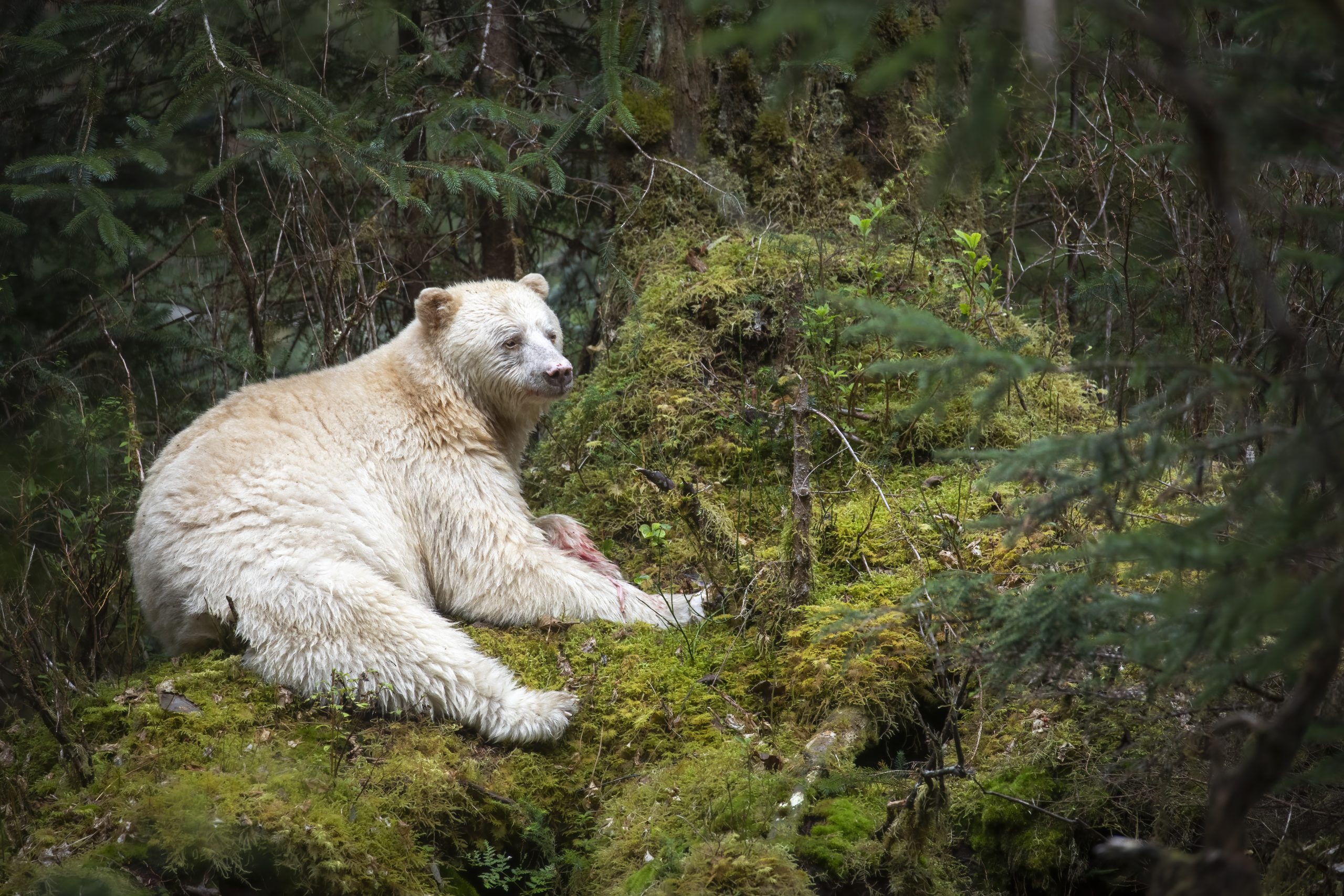
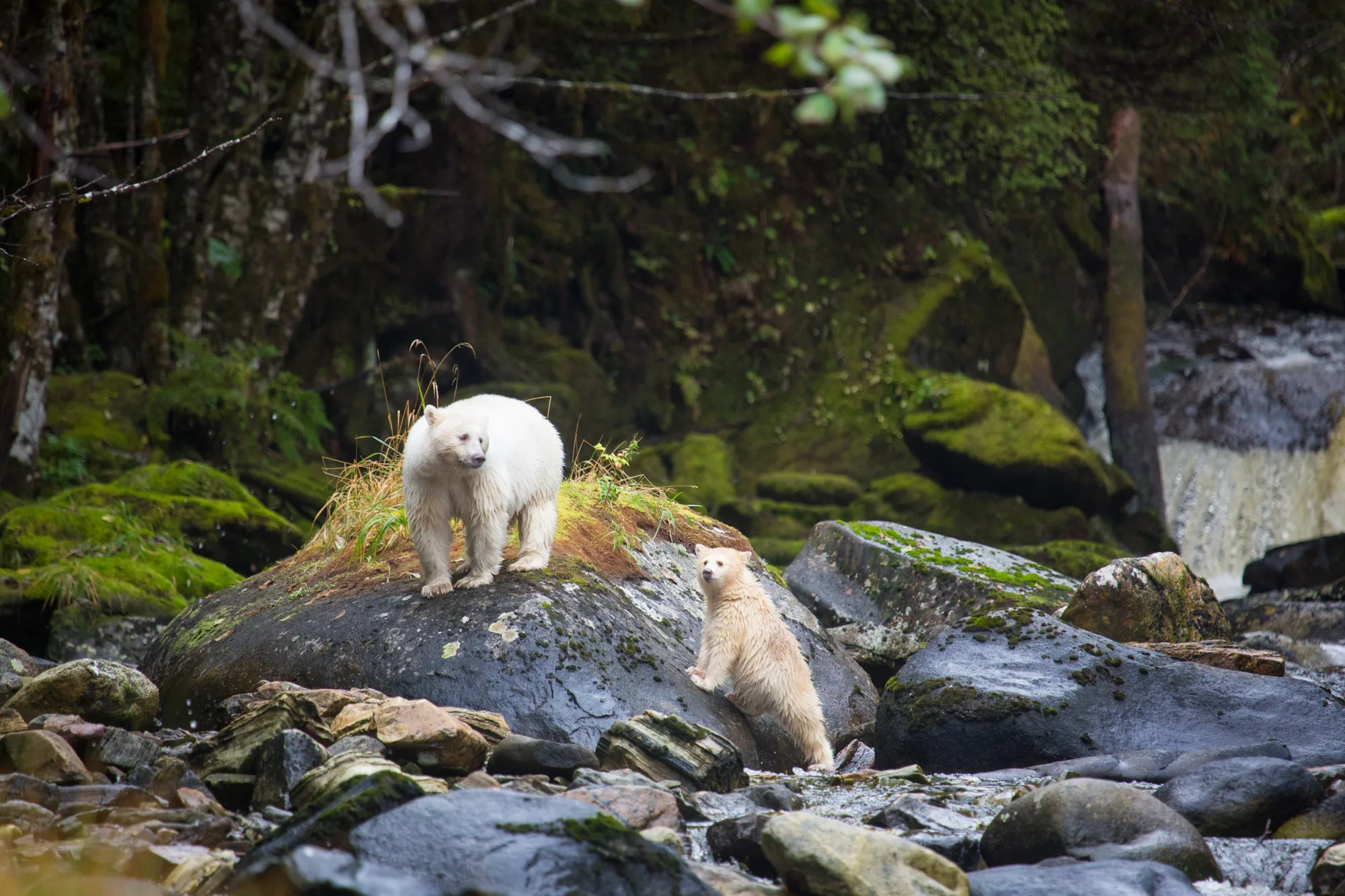
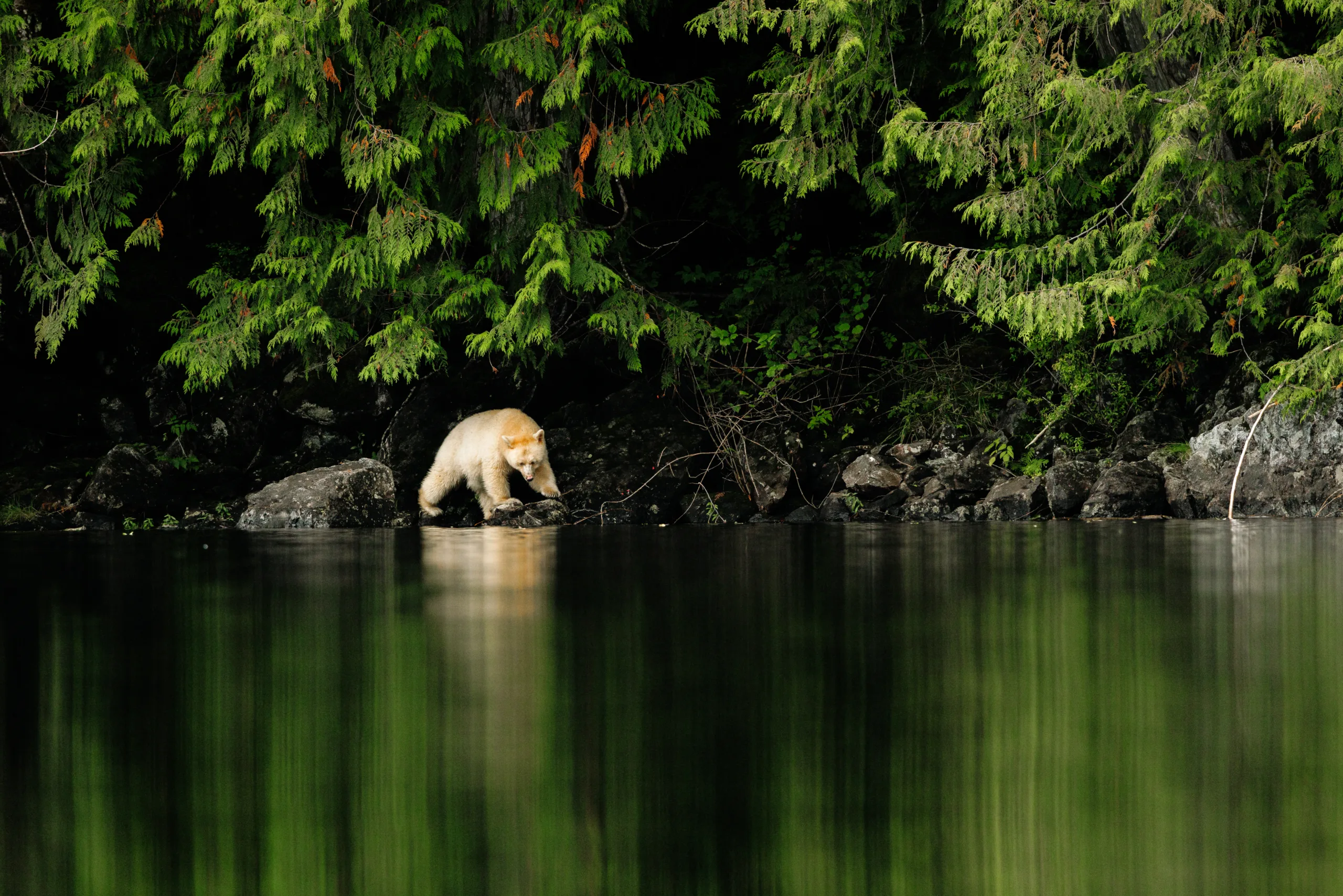
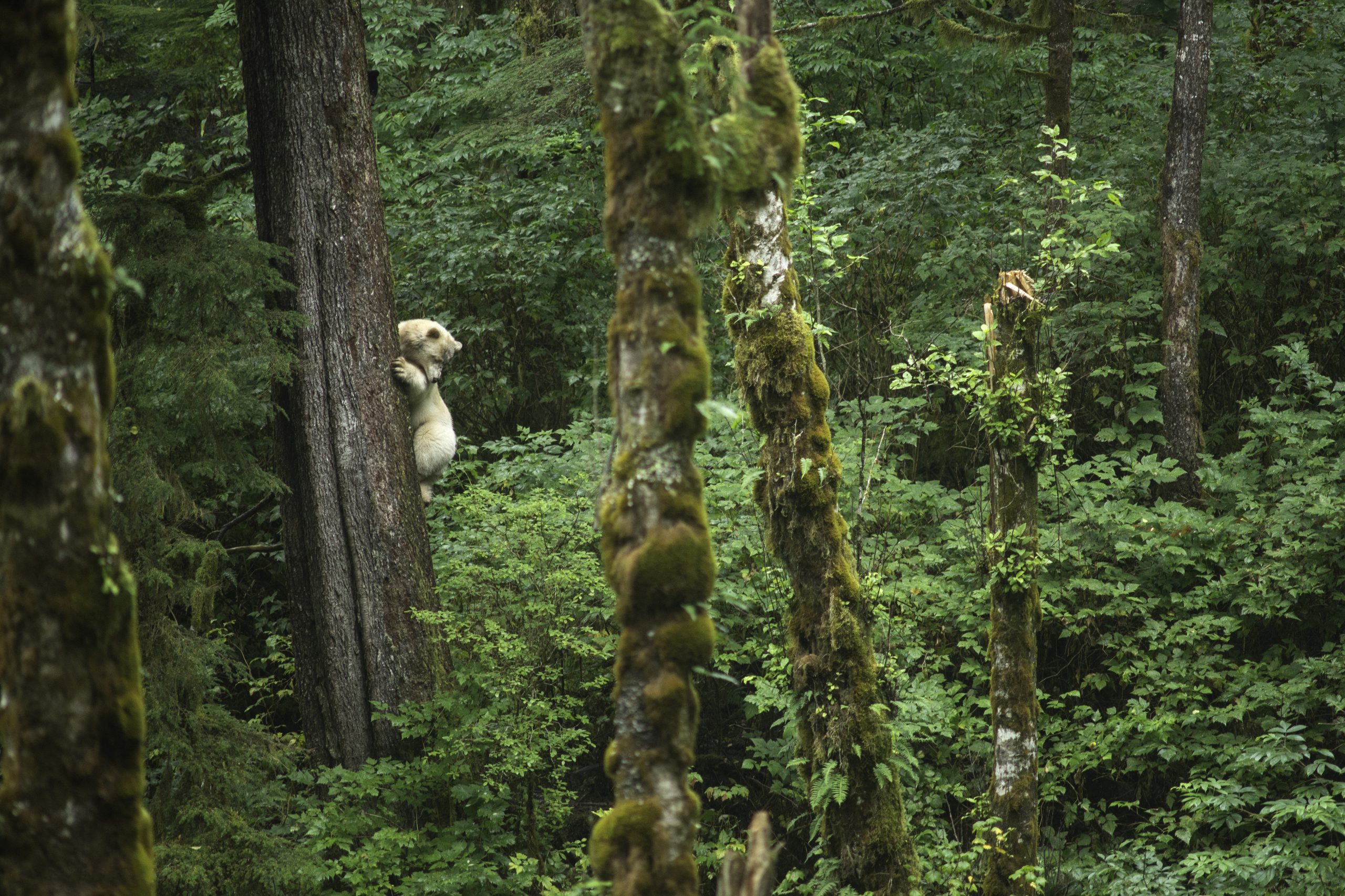
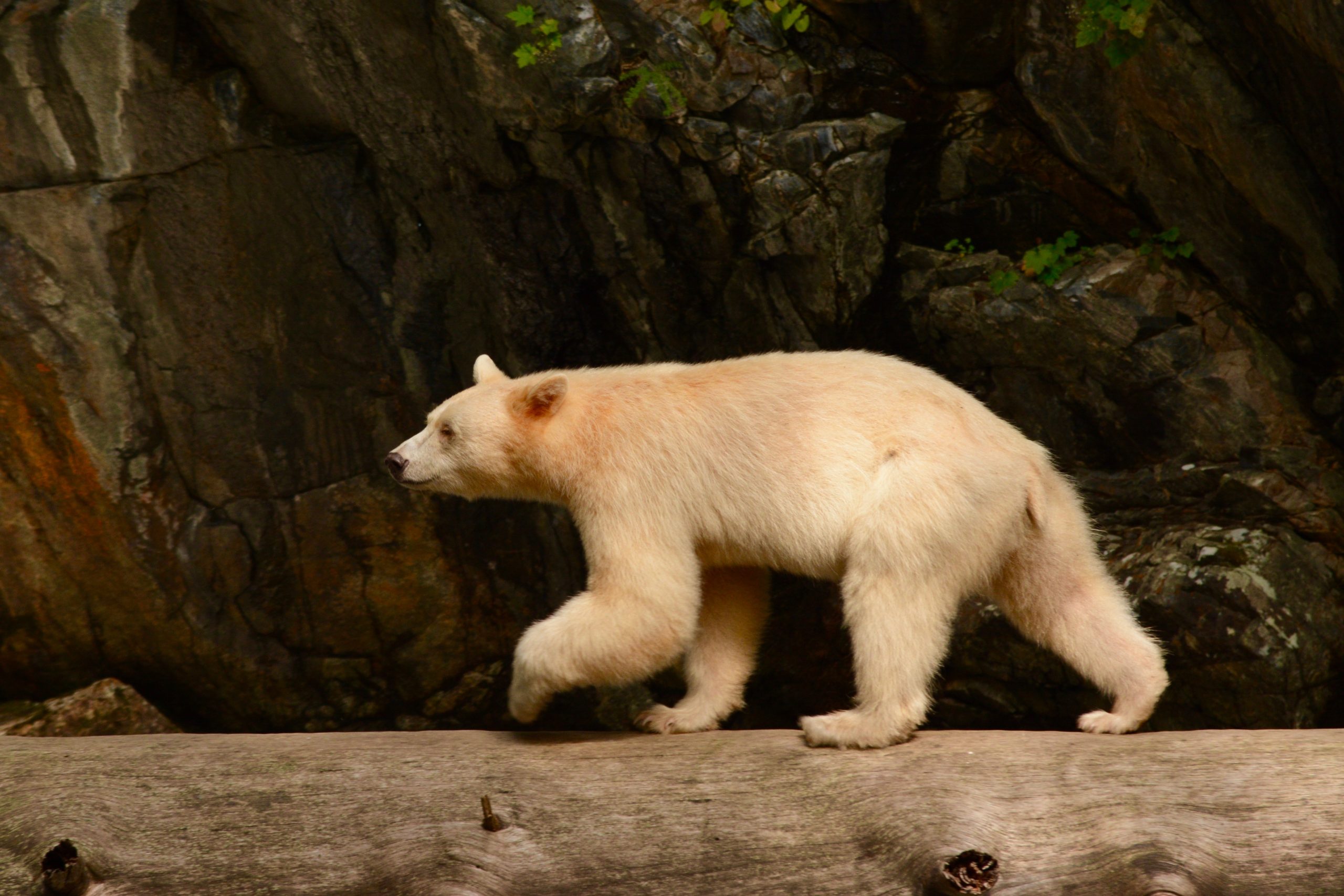
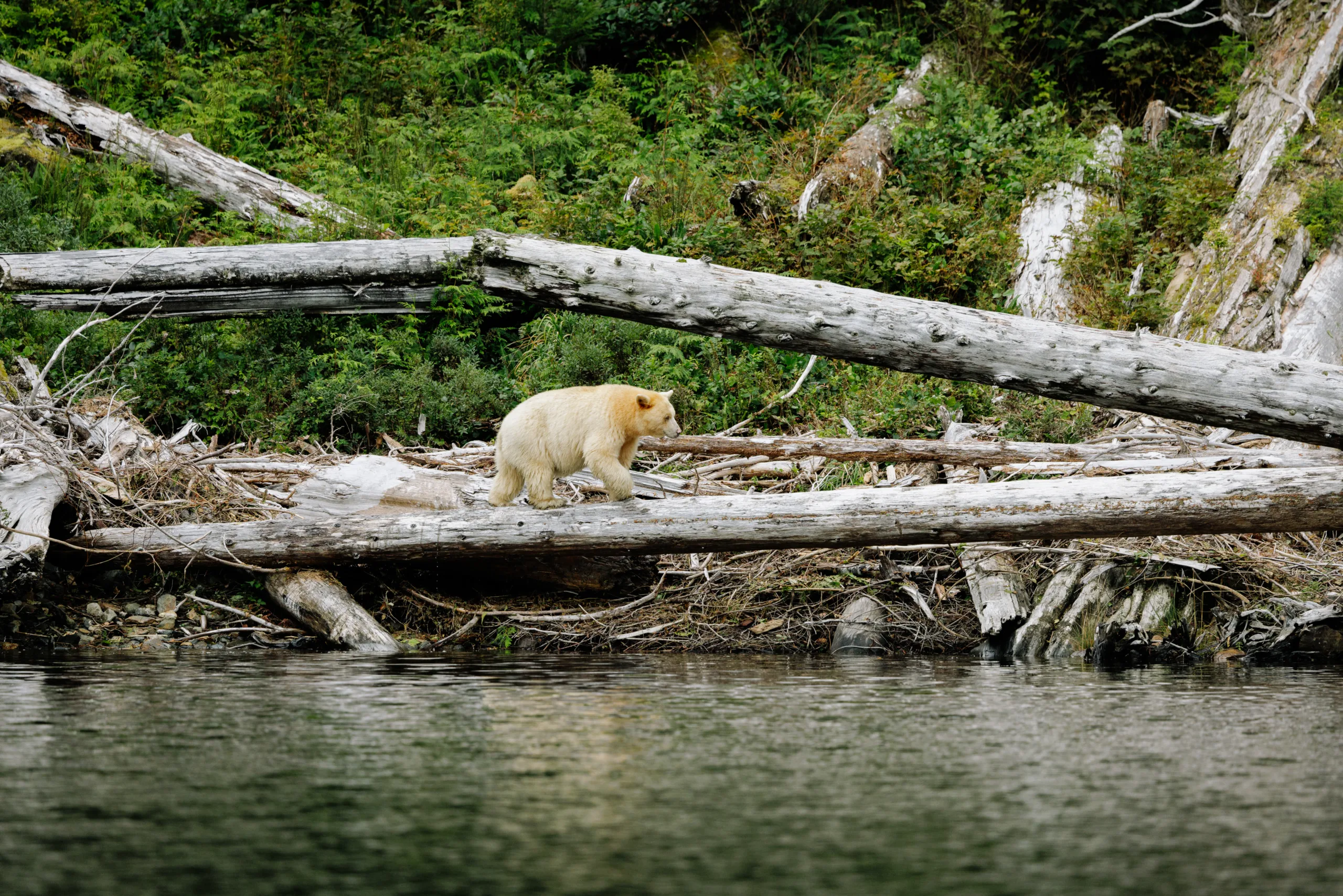
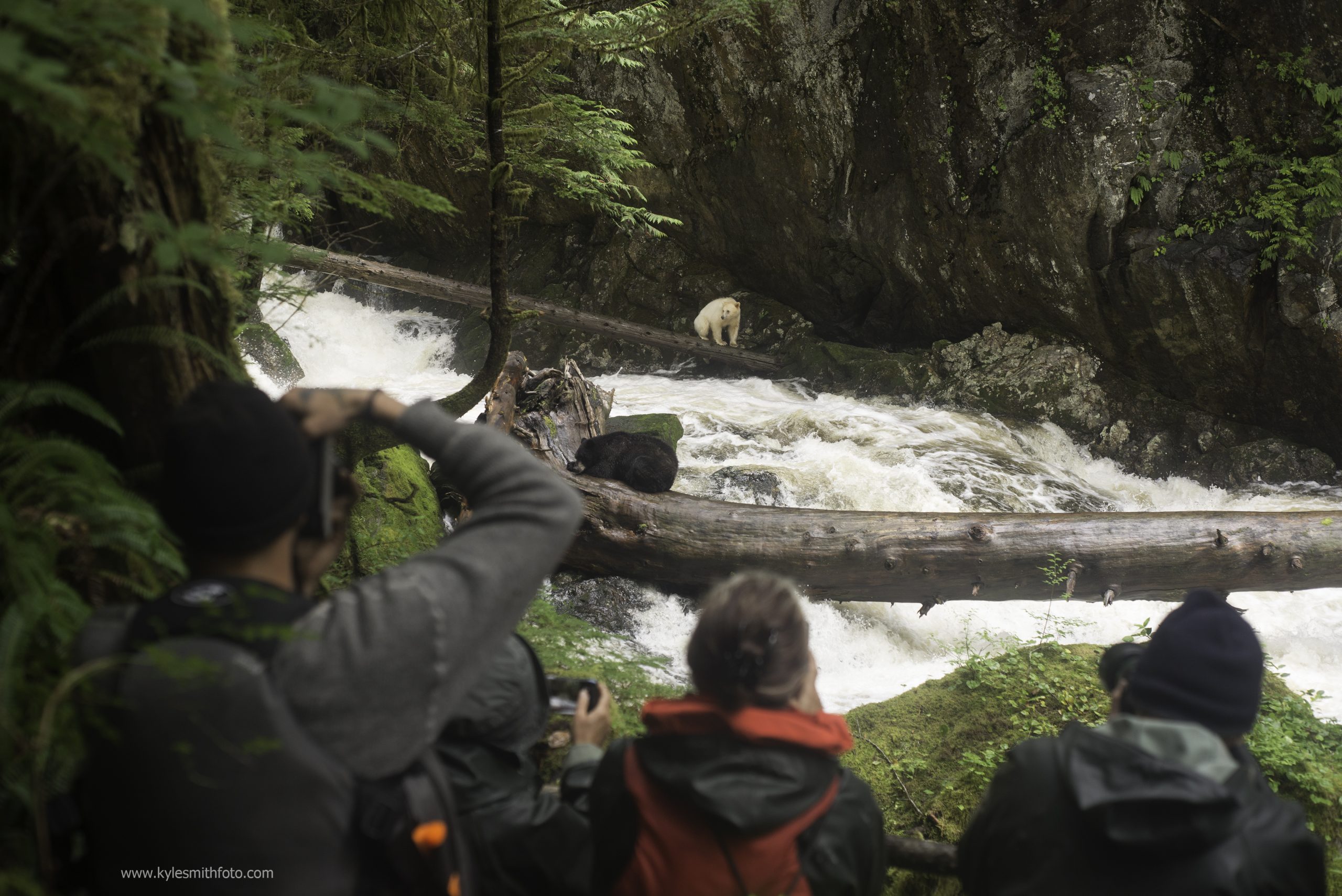
The spirit bear exists only in a small area of the remote northern coast of British Columbia known as The Great Bear Rainforest. It is by far the rarest bear and one of the rarest animals on the planet. The most recent population estimate is between 50 and 150 white-phase individuals. Finding the exact population is nearly impossible due to the challenging topography and dense wilderness of their home range. Spirit Bear Lodge collaborates with Spirit Bear Research Foundation and the Kitasoo Xai’xais Stewardship Authority, which conducted the most recent and rigorous study on the spirit bear population. In this post, in this post we will dive deeper into their range, habitat, numbers and research.

What Is the Current Spirit Bear Population Estimate?
With an estimated 50–150 white phase spirit bear individuals in the wild, the spirit bear is rarer than initially thought. Black bears carry the MCR1 recessive gene that creates the white or cream coloured fur, but you need both parents to carry the gene to make a white-phase bear. Roughly 1 in 10 bears that carry the gene are white which makes the total population between 500 and 1500 bears.
Though the most recent study https://besjournals.onlinelibrary.wiley.com/doi/full/10.1002/2688-8319.12014 was rigorous, it is impossible to know exactly how many spirit bears there are. Their home range is technically a fairly large area, however most bears are found on a few islands on the central coast. The MCR1 gene is most prevalent on Princess Royal Island, most of which lies in Kitasoo Xai’xais Territory. The Kitasoo Xai’xais have protected more than 50% of the landmass in their Territory and the rest of it is under strict ecosystem-based management. Because of this, the primary range of the spirit bear is a roadless wilderness with no settlements other than the small village of Klemtu, which makes surveying for spirit bears extremely challenging. The only viable way to study the population is with hair snag DNA sampling and traditional ecological knowledge. The Kitasoo Xai’xais have worked with Dr. Christina Service and Dr. Wayne McCrory along with other researchers and the University of Victoria’s applied conservation lab, headed by Dr. Chris Darimont.
https://besjournals.onlinelibrary.wiley.com/doi/10.1002/2688-8319.12014
https://coastalfirstnations.ca/resources/spirit-bear-study-reveals-big-gaps-in-protection/
Where Do Spirit Bears Live?
The spirit bears range stretches from the southern border of Kitasoo Xai’ais Territory north of Bella Bella nearly all the way to the Alaska border. That said the majority of the population is restricted to a handful of islands on the central coast. The recessive gene is generally found in less than 1% of black bears on the mainland. Princess Royal has the highest population and is home to The Kitasoo Xai’xais Spirit Bear Conservancy. The Great Bear Rainforest is the only place on earth where spirit bears are found. The Great Bear is 6.4 million hectares of BC’s central and north coast. The Great Bear Rainforest was once known as the mid-coast timber supply area, as it was a largely unlogged area. It is now separated into different management zones with varying levels of protection and allowable resource extraction. Typically, the areas that have historically had resource extraction and infrastructure, such as roads, remain more open to continued forestry or mining. Thankfully, the islands that hold the majority of the recessive gene are protected or under strict management for any forestry operations. The gene found a home on these islands, and because of their location and geographic isolation, it has allowed the recessive gene to persist. Bears do swim from these islands but the numbers that do so are small enough that the chance of a white-phase bear is very small.
Individual bear territories span up to 250 square kilometres, but are often much smaller. They depend on old-growth forests for den sites and adequate seasonal food availability. Salmon are a key food source, and as runs continue to decline, bears will have to shift their diet or move to remaining salmon strongholds. Another concern is the loss of habitat corridors, which can threaten genetic diversity as bears will not range the larger distances to lessen interbreeding.
Why Are Spirit Bear Numbers So Low?
The main reason spirit bear numbers are so low is due to their isolation on these remote islands. The other main reason is the logging of old-growth forests, which has historically reduced available habitat. In 2016, The Great Bear Rainforest Agreement protected 85% of the region, a landmark win for conservation groups and wildlife. The remaining 15% is still open to limited resource extraction, which poses a small threat to spirit bear habitat.
Warming oceans affect Pacific salmon runs, which is one of the black and spirit bear’s primary food sources. Shifting seasons alter the timing of salmon returns, disrupting feeding windows. We are also seeing more extreme weather events which can kill off returning salmon before they spawn with high river temperatures or flood events that wash out eggs.
Spirit bears have such a small, isolated population that they are genetically vulnerable. There is not much movement of bears on and off of the islands that hold most of the bears with the MCR1 gene. Being largely restricted to these islands and habitat fragmentations increases the likelihood of inbreeding, further decreasing genetic diversity. Spirit bears could become even rarer with increased habitat fragmentation.
After many years of pressure from NGO’s and First Nations BC banned grizzly bear trophy hunting in 2017, and in 2022 the black bear hunt was closed in Kitasoo Xai’xais and Gitgat Territory to protect spirit bear genetics.
In recent times, spirit bears could not be hunted, but they were hunted historically for pelts and to be displayed in museums.

What Is Being Done to Protect Spirit Bears?
In 2006, the spirit bear became British Columbia’s provincial animal. With hunting now banned for black bears in the majority of their range spirit bears have a stronghold to protect their population for generations to come. Every guest that visits Spirit Bear Lodge contributes to a conservation fee which furthers research and supports increasing habitat protection.
With collaboration between the BC government, First Nations, industry, and environmental groups in 2016 the landmark Great Bear Rainforest agreement was signed and much of the coast was protected once and for all. The GBR agreement protected over 3.1 million hectares of old-growth forest from logging and established ecosystem-based management standards across the region to ensure key habitats were protected.
The Kitasoo/Xai’xais and other coastal First Nations are the guardians of the spirit bear. Guardian Watchmen programs monitor wildlife, habitat, and visitor activity in the region. Traditional Ecological Knowledge is now integrated into modern science and conservation planning.
There are ongoing efforts to study spirit bears. Spirit Bear Lodge is leading an extensive wildlife inventory research program using remote cameras. The Kitasoo Xai’xais Stewardship Authority and Spirit Bear Lodge are currently raising funds to initiate another study using hair snags focused on the spirit bear population.
Spirit Bear Lodge is owned and operated by the Kitasoo Xai’xais First Nation. The lodge supports a conservation-based economy by providing an alternative to resource extraction. As a guest of Spirit Bear Lodge, you support a remote Indigenous community, research and conservation.
Spirit Bear Facts
Did you know:
- Spirit bears may be better fishers than black bears; their white coat reflects less light underwater, making them less visible to salmon.
- A spirit bear cub born to two black coloured bears is possible if both parents carry the recessive gene.
- The spirit bear is the official provincial mammal of British Columbia (since 2006).
- Known as ‘moskgm’ol’ in the Tsimshian language and ‘Mooksgm’ol’ in Sm’algyax.
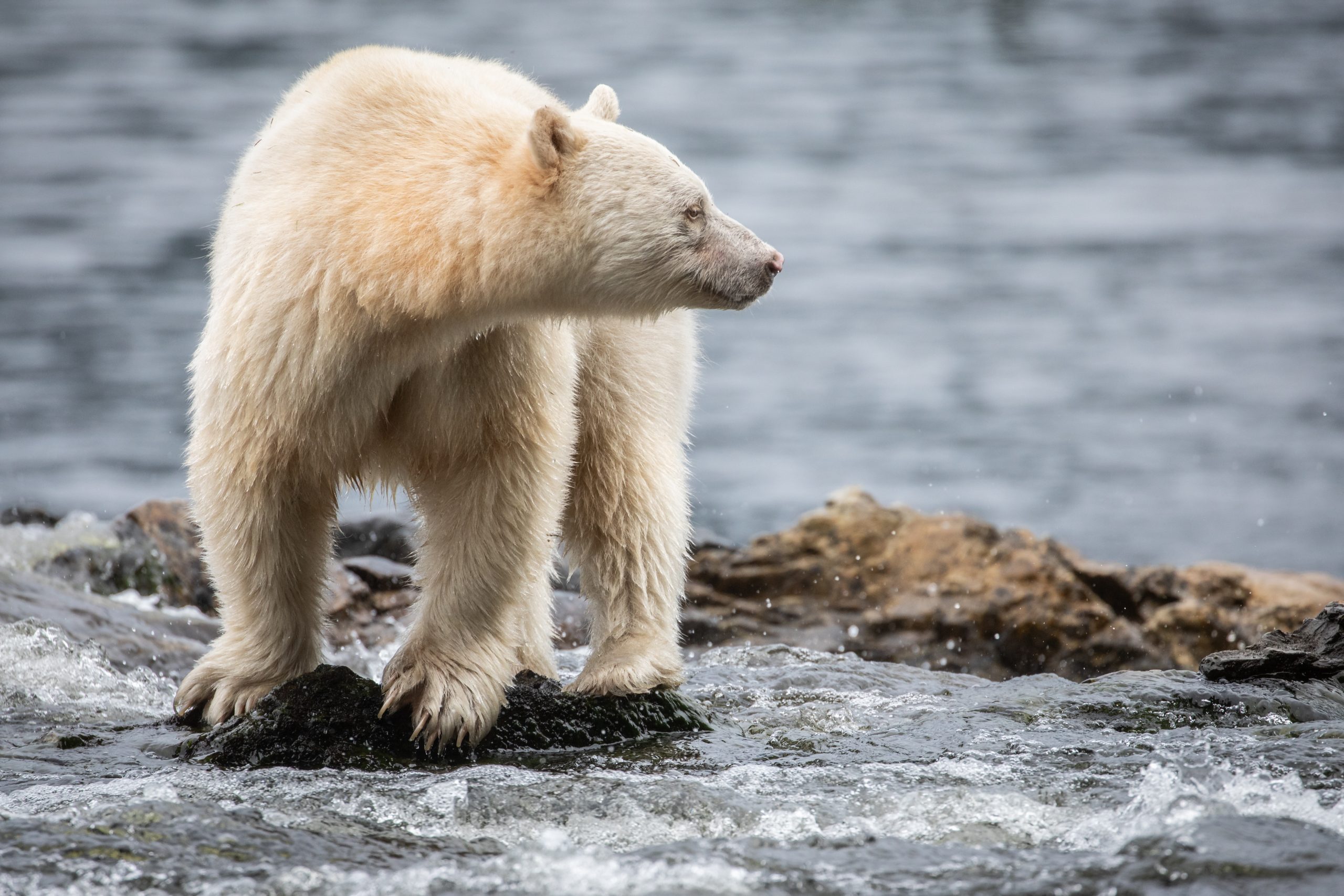
- They are not albinos — their eyes and skin are normally pigmented.
- A single spirit bear can consume up to 20,000 calories per day during salmon season.
- Spirit bears are not endangered as they are technically a black bear (Ursus Amercanus) with a recessive gene.
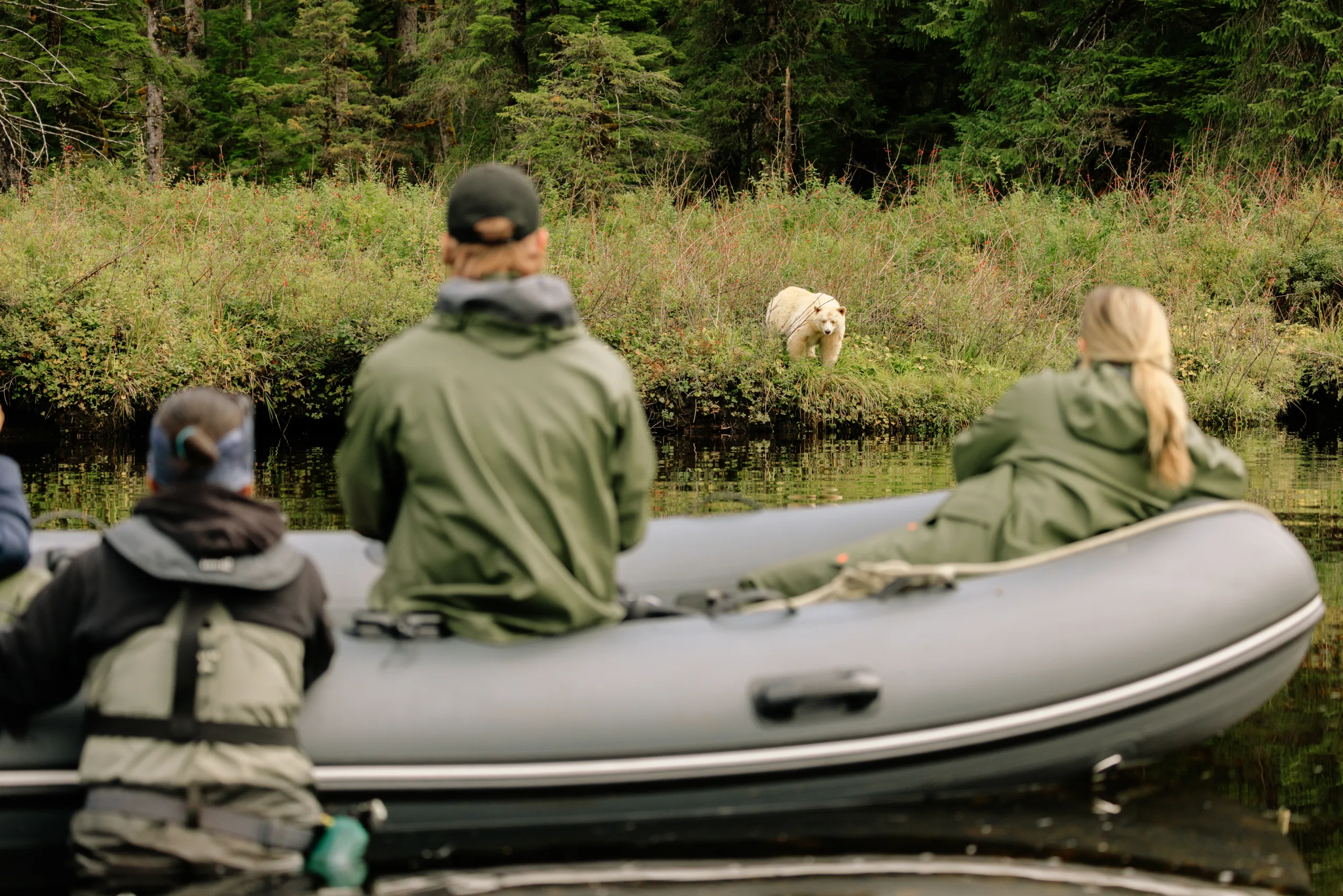
- You can see a spirit bear without going on a tour, but it is extremely challenging. You would require a boat and specialized knowledge of where to find them. All of the areas Spirit Bear Lodge views spirit bears have restricted access to Spirit Bear Lodge only.
- Spirit bears have no relation to polar bears, other than their colour.